Filmmaking LAB
PIPELINE FAQ The Ask
Pre-seed · In active development · Engine live at v2.2

Any written story
becomes a complete film.

One pipeline. Zero film expertise. Every phase handled, every technical decision made — the director just tells the story.

SCROLL
The Problem

Writing the story is the easy part. Everything after is locked behind tools, experts and budgets.

Creators & authors
Locked out
Casting, locations, props, sequences, shots, reference images, video generation, post-production — each step a separate tool, a separate expert, a separate budget. Independent authors have no way in.
Producers
$50K–500K
and 6–18 months for pre-visualization. Pitching investors with no visual material is a competitive disadvantage.
Game studios
$500K–5M
per cinematic, outsourced to specialist studios. Indie studios have no access at any price.
Universal
The hidden tax. Every AI tool available today demands one thing from the person using it: choose your model. Which one for faces. Which one for landscapes. Which one for video. What was deprecated last week. What shipped yesterday. Staying current is a full-time job — and it falls on the creator, every time.
Why Now

AI generation crossed into usable quality. Nobody has connected the pipeline.

The field moves every week — new model releases, quiet deprecations, sudden jumps in fidelity. Filmmaking LAB already locks a reference image and carries it — same face, same costume, same identity — through every shot; that part is built and running today. As the models underneath keep improving, the output improves with them automatically.
6–9
months
to the full five-phase pipeline
"I know AI will reach that point. I just want to be prepared for that. And I know it's not going to take too long."
— Founder & CEO
Built to compound with every model release — not built around waiting for one.
The Solution

A five-phase pipeline. The director never writes a prompt.

01
Project
Upload the story. Run the Decomposition Engine.
02
Development
Review every extracted asset — cast, scenarios, props, shots. Approve, reject, flag.
03
Pre-Production
Enrich each asset in the Asset Studio, generate its reference image, lock it.
04
Production
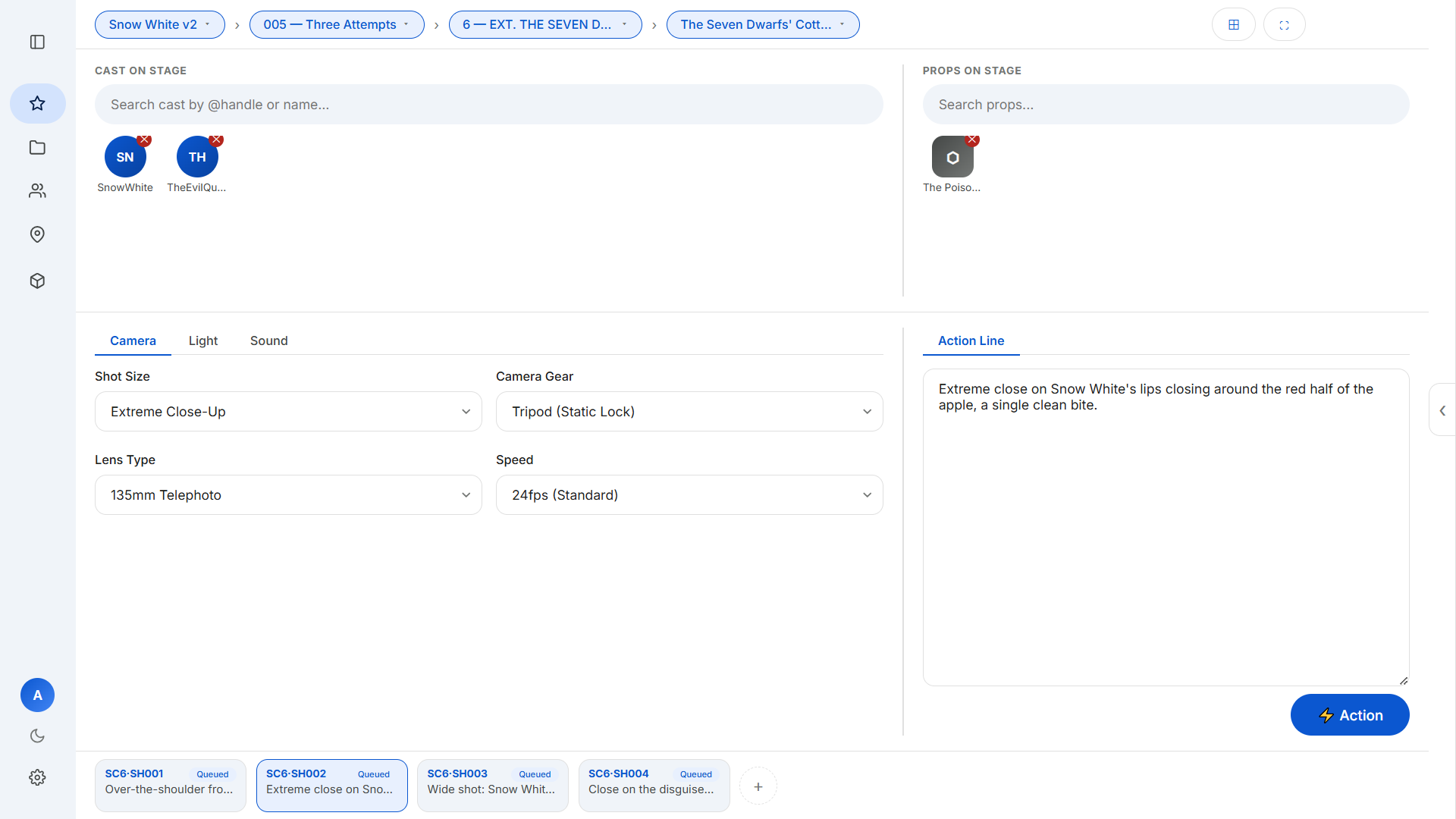
Assign locked assets to shots on the Studio Floor. Generate video. Approve.
05
Post-Production
Assemble the edit in the Edit Suite. Layer ambient sound, character speech and score. Apply transitions, VFX and SFX. Export.
From a 90-second pitch trailer to a feature-length film — every format runs through the same pipeline. The scope changes. The process doesn't.
Product Today

The hard part is already built.

3 of 5 phases shipped
Live and running
Decomposition Engine v2.2 — the moat
Adapts any written work into a Fountain screenplay, then the full shootable structure: cast with physical, styling and performance metadata; scenarios with cinematographic specs; props; and the sequence → scene → shot hierarchy.
A production system, not a prototype
Every AI model inside Filmmaking LAB is tested, benchmarked and selected by the platform — not chosen by the director. Every generation is logged, traceable and auditable. When a model fails a real task, the platform routes to a better one. That resilience isn't promised — it was proven in development.
Phases 1, 2 & 3, complete
Project workspace, the Development review flow, and the Asset Studio in Pre-Production. Every character, scenario and prop locks to a first version — then supports real production variation on top of it: multiple wardrobes and ages per character, season and day/night per scenario, condition changes per prop, all traceable back to the same locked identity.
Spec'd, next to build
Production — the Studio Floor: shot-level video generation against locked assets.
Post-Production — the Edit Suite: timeline, audio layers, export.
Cross-model arbitration — platform-wide. Every task across all five phases routes to the optimal model automatically: image generation, video synthesis, sound design, visual effects. The director never selects a model. The platform never stops benchmarking.
Production-grade infrastructure · every page spec-approved before code
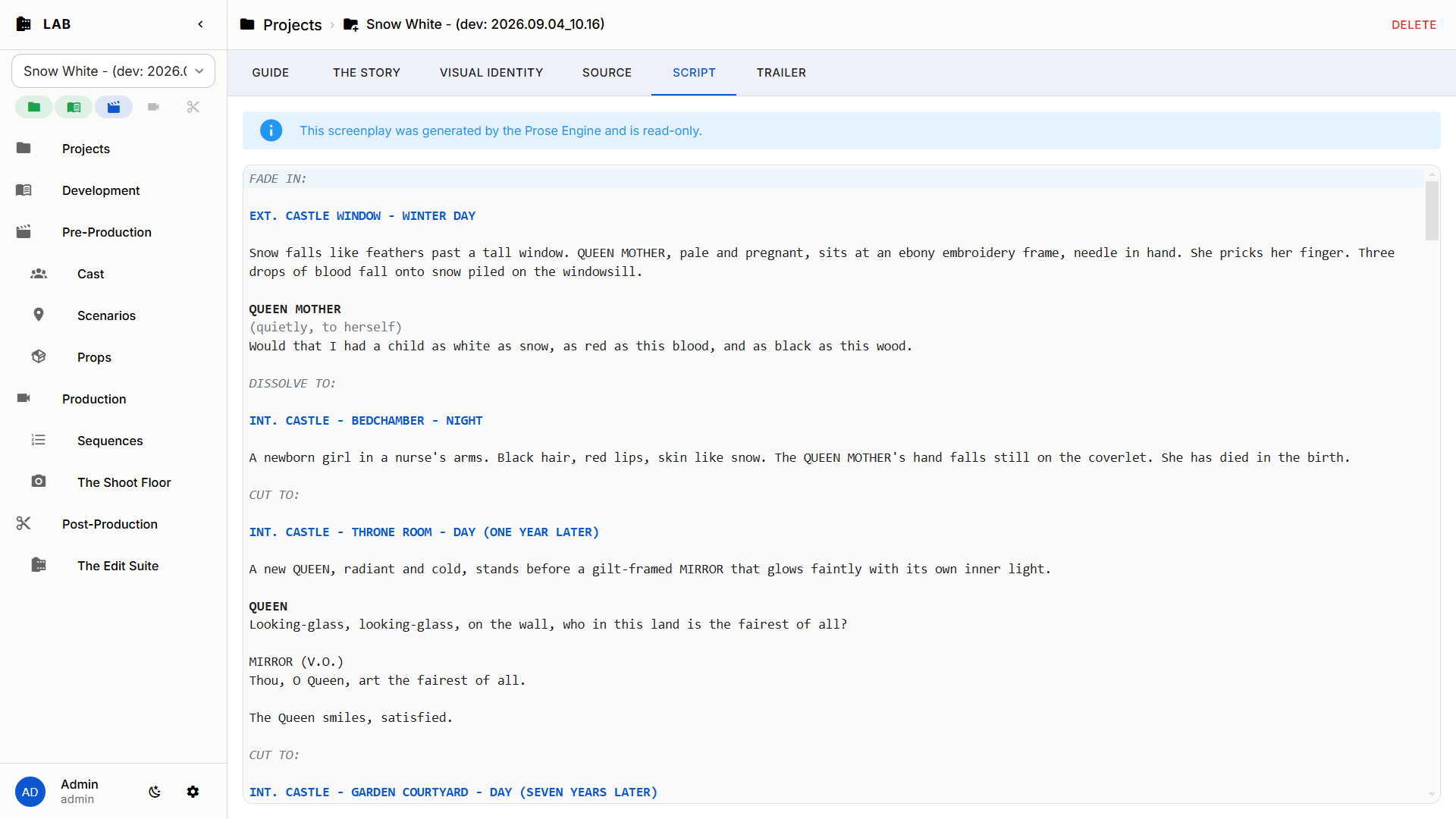
Screenplay — generated by the Decomposition Engine
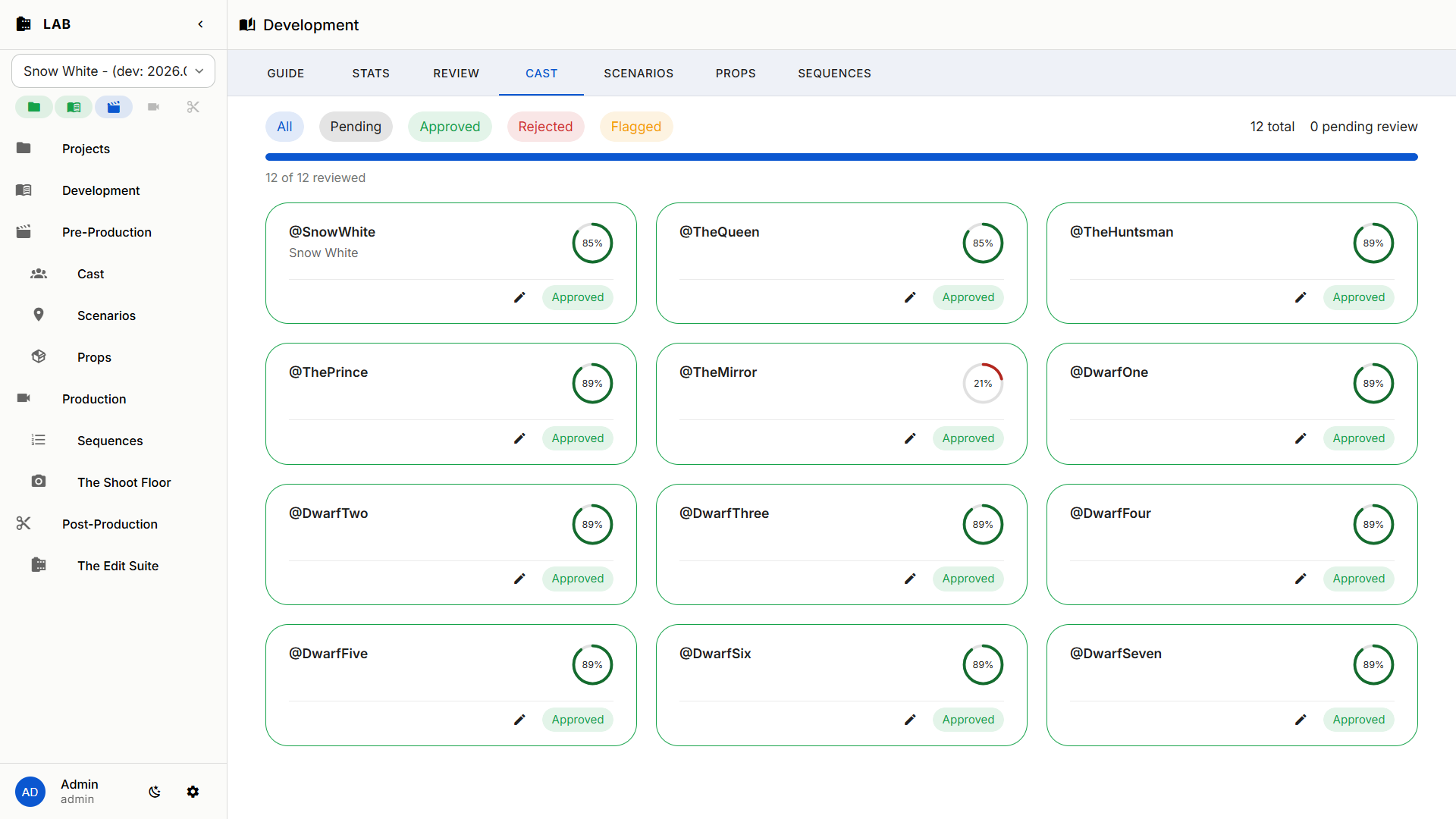
Development review — cast approved and scored
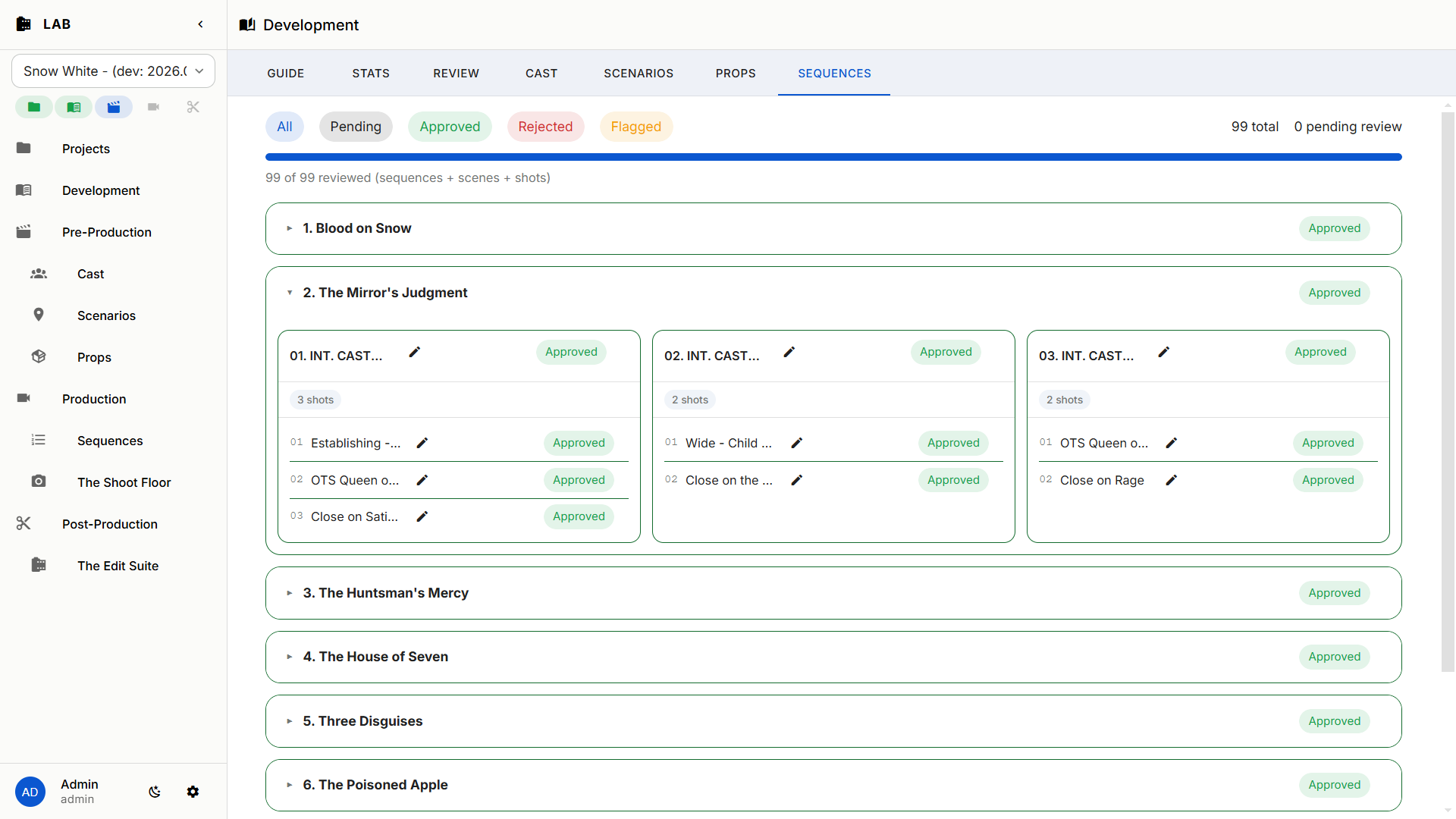
Shot hierarchy — sequence → scene → shot
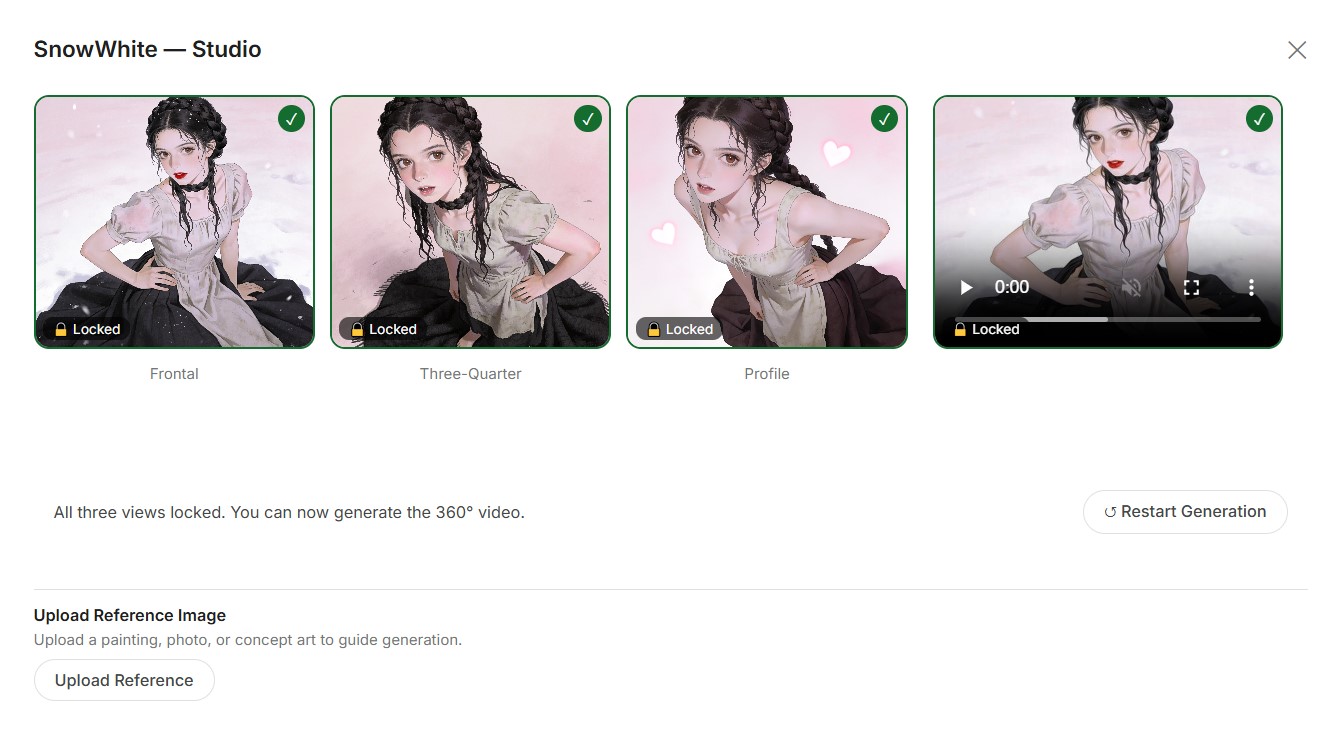
Asset Studio — three views locked, reference video ready
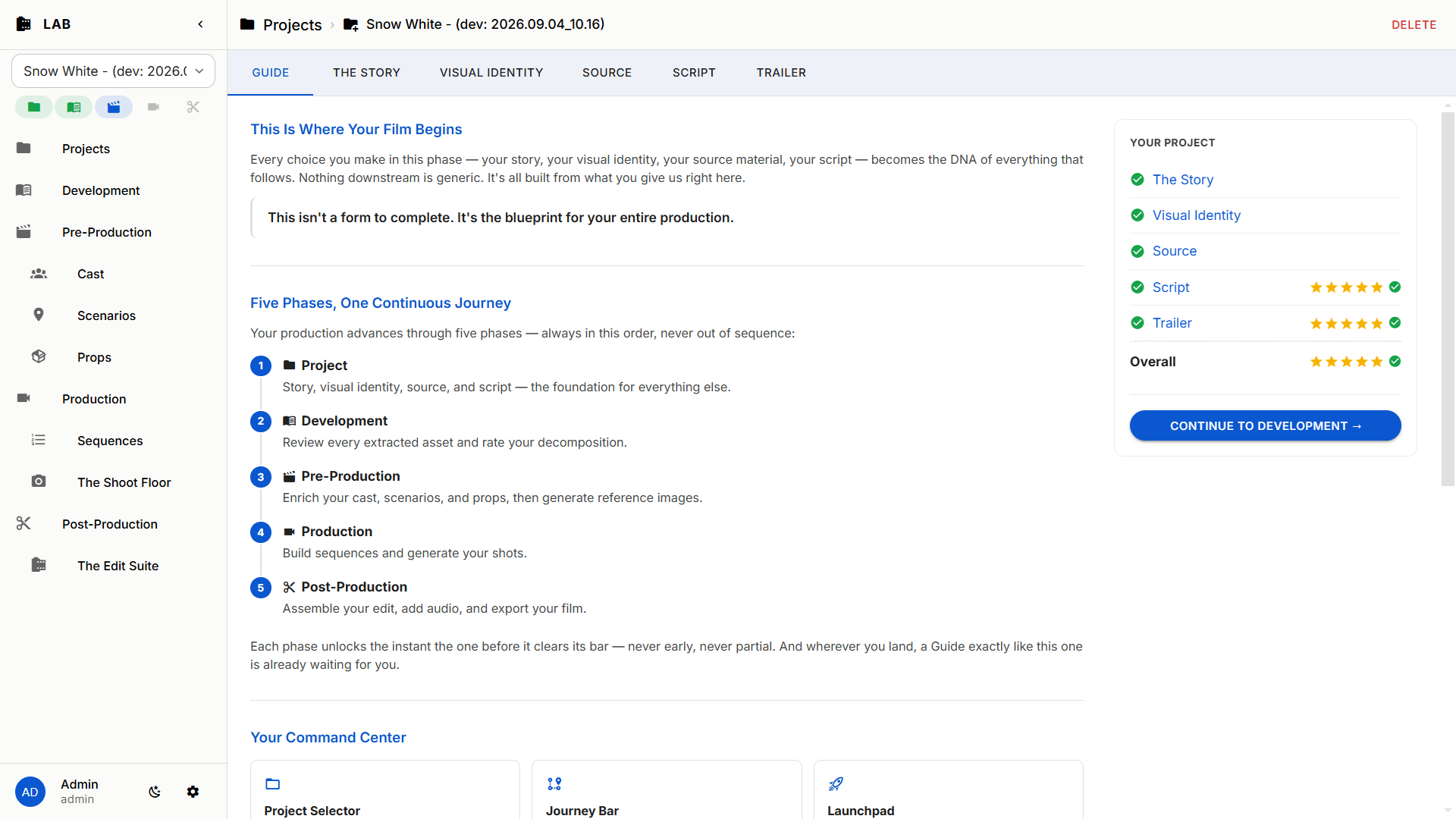
Project guide — five phases, one continuous journey
Studio Floor — shot-level production, assets locked and staged
The Moat

What no competitor has.

01
End-to-end pipeline
Runway generates video. Midjourney generates images. Flow adds tools. Nobody connects the whole line.
02
Zero expertise required
Narrative in, film out. Every cinematic decision is made on the director's behalf.
03 · built
Automatic model routing
Directors never see a model name. The platform benchmarks continuously, routes each task to the best model, upgrades silently, absorbs deprecations invisibly.
04 · built
Locked reference contracts
Every approved reference travels through every shot — same face, same costume, same identity. This is what makes the output a film, not a slideshow.
05
Value-based pricing
The platform charges for what the output delivers to the creator — not for what it costs to generate.
The flywheel: Every production run makes the platform smarter. Every director rating sharpens the routing. Every model release raises the output ceiling — automatically, invisibly, without the director doing a thing. The compounding advantage widens with every film shipped.
Market

Three buyers. Every one has a named budget line and an active pain.

Film producers
$50K–500K and 6–18 months for pre-viz — pitching investors blind.
Pre-visualization budget
Indie game studios
$500K–5M per cinematic, outsourced — or no access at any price.
Cinematic outsourcing budget
Marketing agencies
Brand films take weeks and cost tens of thousands — briefs sit waiting.
Agency production budget
Primary wedge: film producers. A pitch trailer generated from their script before a single frame is shot is a deliverable they need right now, priced at a fraction of what pre-viz costs today.
Secondary segments — screenwriters, book authors, educators, corporate comms — addressable on the same pipeline from Year 2 onward.
Go-To-Market

Three channels, zero ad spend at launch.

Bridge period · months 1–9, pre-launch
Identify 20 indie film producers in active pre-production (IMDbPro, Film Independent, Sundance Labs).
Offer 3–5 free pilot runs on real scripts.
Goal: signed Letters of Intent before seed closes.
Launch · Year 1, seed-funded
Sales hire focused exclusively on film producers and indie game studios.
Organic distribution: one public pipeline demo — story in, trailer out — posted to Stage 32, No Film School, IndieWire communities.
Partnership outreach to screenwriting platforms (Coverfly, Final Draft) — they have the audience, we have the pipeline.
Proof point
A single publicly shareable trailer, generated from a real producer's script through the full five-phase pipeline, is the marketing asset and the sales tool simultaneously.
Business Model

We don't sell generations. We sell productions.

Filmmaking LAB is credit-based. Credits don't buy generations — they buy production outcomes. A credit spent defines a character, not an image. Structures a screenplay, not a text completion. Builds a trailer, not a video clip. What happens inside each outcome — which models run, how many iterations, what gets stored — is invisible to the director. That's the platform's job, not theirs.
Creator
Platform access · base credit allotment
$99/mo
Studio
Platform access · expanded credits · priority routing
$399/mo
Enterprise
Custom credits · dedicated routing · SLA
Contact Sales
Top-up credits scale with every project — this is where usage revenue grows.
What credits unlock
A Decomposition — a written story becomes a complete shootable production blueprint.
A Trailer — a script becomes a 90-second pitch-ready film.
A Game Cinematic — a brief becomes a fully locked character-driven scene.
Projection

$16.2M ARR by year five. Cash-flow positive.

YEAR 0
Bridge · pipeline completion · Funding $185K
—
YEAR 1
Seed deployed · launch · Funding $1.2M
$450K
YEAR 2
Growth · no raise
$1.35M
YEAR 3
Series A opens early · closes mid-Y3 · Funding $2.5M
$4.05M
YEAR 4
Scale · near breakeven
$8.1M
YEAR 5
Cash-flow positive
$16.2M
Total funding across 3 rounds: $3.885M
An orchestration layer on existing AI models, not a foundation-model builder — structurally lower capital intensity than most AI-native SaaS, with no training costs and no infrastructure to own. Burn-multiple modeling will sharpen as real usage data comes in.
Investor Returns

The same capital, held longer.

The bridge dollar is the highest-conviction position in this structure: earliest entry, smallest check, most time to compound. The figures below represent cumulative returns across all three investor rounds combined.
Exit year 3 · conservative floor
3.2–4.9×
Valuation $40M–$60M
Investor share 31.6%
Payout $12.6M–$19M
Exit year 4 · mid case
5.3–8.1×
Valuation $65M–$100M
Investor share 31.6%
Payout $20.5M–$31.6M
Exit year 5 · target case
10.6–15.9×
Valuation $130M–$195M
Investor share 31.6%
Payout $41.1M–$61.6M
$3.885Mtotal raised, 3 rounds
31.6%cumulative investor ownership after compounding dilution — founders retain 68.4%
Valuations benchmarked against 2025–2026 AI-native SaaS market data: 10–15× ARR at Series A stage, 8–12× at maturity (Carta, PitchBook, SVB). Series A pre-money of ~$50M on $4M ARR is consistent with current AI SaaS comps. Planning assumptions: 10% / 20% / 5% dilution across bridge, seed and Series A respectively.
Competition

Alone in the full-pipeline, zero-expertise quadrant.

High expertiseZero expertise
FULL PIPELINE
Blur · Digic · Axis
$500K+, 12 months, humans only
FULL PIPELINE
Filmmaking LAB
Narrative in, film out
ONE PHASE
Unreal Engine
Deep technical expertise required
ONE PHASE
Runway · Pika · Sora · Flow
Generation, no narrative structure
The third axis
Every competitor makes the user choose the model.
Filmmaking LAB chooses — always optimal, always current, invisible. A deprecation upstream is a database row here, not a customer incident.
Image and video generators are our suppliers, not our competitors. Every model that gets better makes our output better.
Team

A capability story, not just a founder story.

Twenty years spanning software architecture, data modeling, and Oracle database administration — including a career built inside IBM. The founder has shipped complex systems, managed large-scale infrastructure, and now applies that same rigor to a new discipline: directing AI coding agents to build production-grade software. Filmmaking LAB isn't a first attempt at something complex. It's what a career's worth of engineering judgment looks like when it meets the fastest-moving platform shift in software history.
Spec-first
Every page approved before a line of code. 14+ models live-verified across three providers. Full call traceability on every AI interaction.
Why solo, why now
Pre-seed is exactly the stage built for one technical founder to prove the hardest part alone. Traction follows the raise, not the other way around — the Decomposition Engine already running end-to-end is the proof point in place of it.
Next hires, post-funding
A sales lead. A co-founder with complementary design and distribution strength. A part-time technical PM from month three.
The Ask

Raising $185K now — a bridge to a demo-ready pipeline.

Y0 · Bridge / Angel
$185K
6–9 months to close the pipeline: Production and Post-Production shipped, AWS deployment, part-time technical PM from month three.
10% dilutionMilestone: end-to-end film, generated
Y1 · Seed
$1.2M
Launch. Sales hire, marketing, infrastructure at load. $450K ARR in the same year.
20% dilution
Y3 · Series A — opens early, closes mid-Y3
$2.5M
Scale acceleration on $4.05M ARR. Projected pre-money ~$50M, consistent with AI SaaS market benchmarks at this revenue level.
5% dilution
Rounds are sized to the model's own cumulative net burn plus an 18–24 month runway buffer — not to market-median round sizes.

The director just tells the story.
We handle everything else.

"We don't price on what it costs us to generate. We price on what the output is worth to the creator."
Filmmaking LABBridge round open · $185KRequest a demo